The Contract Is Part of the Design

One of the design projects I'm most proud of at HUTS isn't a house or a property at all.
It's our contract.
Standard contracts in the AEC space read like they were written to protect the firm from you. Dense paragraphs and compounded clauses. Scope described in language that assumes you already understand what you're signing up for. It's a document optimized for the firm's legal department, not for the person sitting across the table trying to figure out what they're getting into and what it's going to cost.
I think that's bad information design.
And, if there’s anything we strive for at HUTS it’s for our clients to know where they’re headed and to have a clear view of the steps to get there.
So I built our Scope of Work the same way HUTS approaches property design and development: componentized, clearly organized, and scaled to what a specific client actually needs.
I often describe it as a “dim sum” model.
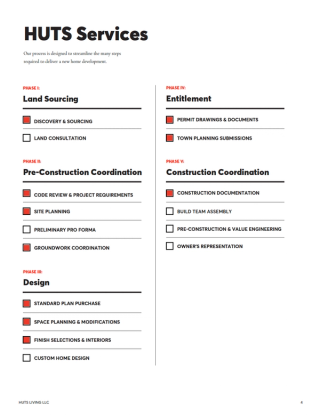
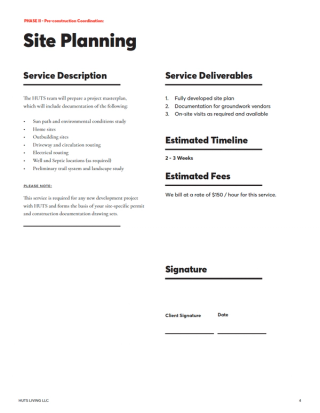
Our services are broken into discrete, legible phases — Land Sourcing, Pre-Construction Coordination, Design, Permitting, Entitlement, Construction Coordination — each one its own plate on the cart. Every phase has a plain-language description of what we do, a defined set of deliverables, and fee and timeline range established by what we've actually spent on comparable past work.
You take what you need and skip what you don't.
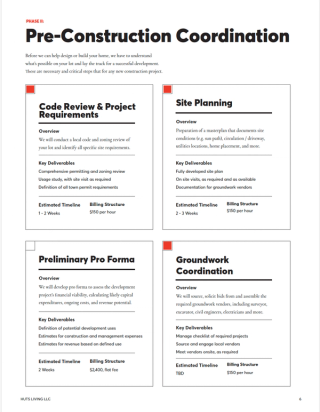
A client who already owns their land and knows what they want to build doesn't need Discovery & Sourcing. A client who's coming to us with an existing builder they're already committed to doesn't need us assembling a build team. The contract should reflect that reality rather than pretend every client arrives at the same starting line.
The way information is organized, the language used to describe a service, the visual structure of a document: these are all design problems. And like any design problem, the goal is to make something complex feel navigable rather than overwhelming.
I spend a lot of time thinking about what appropriately-scaled housing looks like — homes that fit the actual lives of the people who will live in them, not just a price point or a square footage target. The same logic applies to the contract. It should fit the engagement, not impose a one-size structure that serves HUTS’s convenience at the client's expense.
When someone is committing to build a home — especially a first home, a multigenerational project, or a rural land development they've never attempted before — they deserve a clear picture of the road ahead from the first document they sign.


